

Joyful mess – Workshops
LIFE AT MOTOCO, WITH YOU IN IT
Twice a year, we open the studio doors and invite you in to discover the artworks, meet the people who make them, and see the spaces where they came to life. This time, we wanted to push those doors a little further open and give you access to everything that happens in between: ideas being passed around, skills being shared, objects being repurposed, experiments, failures, collective bursts of enthusiasm, and that curious tendency to take very seriously things that, at first glance, seem to have very little practical use.
For two days (26th and 27th September), motoco will therefore look exactly like motoco. Only with you in it.
A quick tour of the workshops:
1) Introduction to wet plate collodion, following in the footsteps of photography’s pioneers – Led by Julien Félix
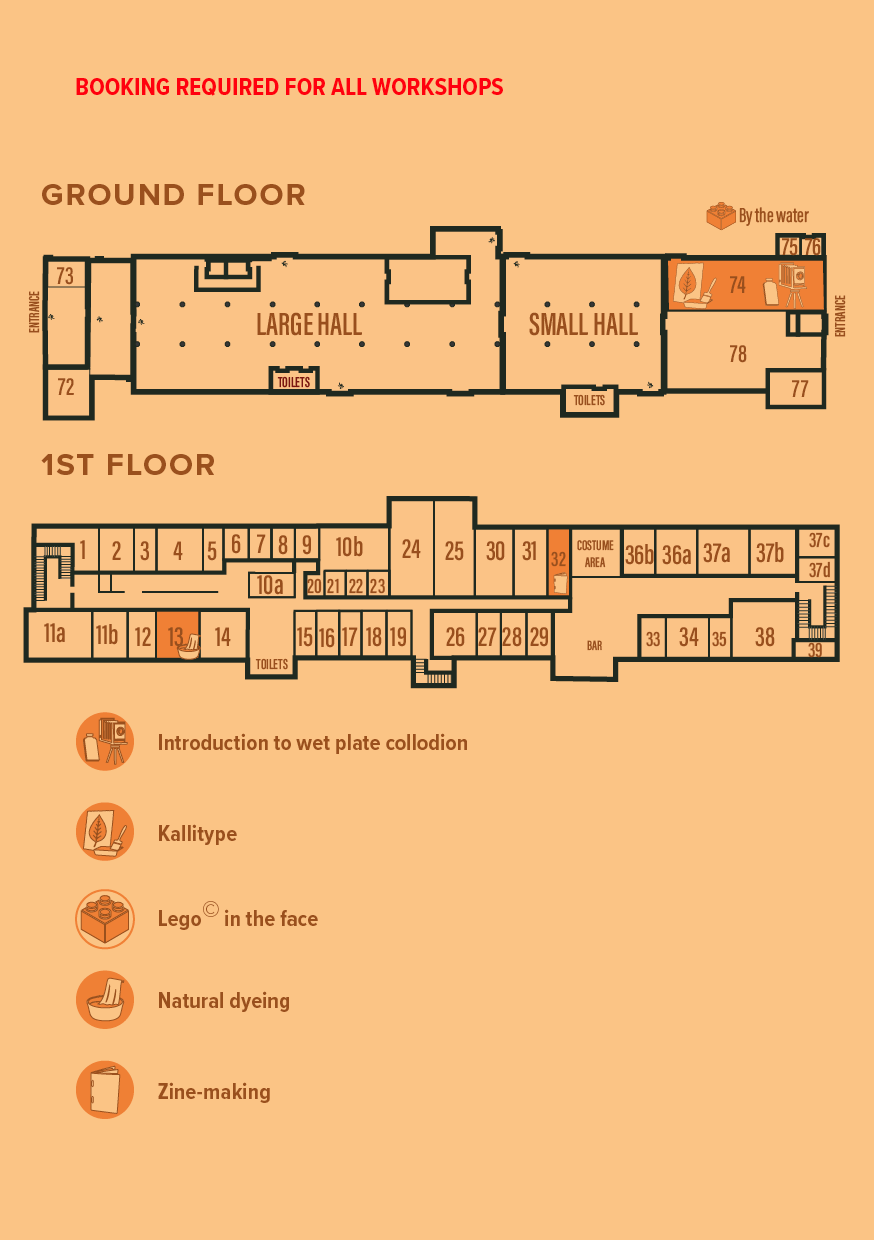
Saturday, 9 am – 5 pm – Le Réverbère studio (74)
Attributed either to the Englishman Frederick Scott Archer or to the Frenchman Gustave Le Gray in the 1850s, the discovery of the wet plate collodion process was a major breakthrough in the history of photography. Like all historical photographic techniques, it allows photographers to control the process from start to finish. This workshop will help demystify the technique and give you a solid foundation for your future experiments.
Morning (9 am–12 pm):
– Technical theory
– Safety guidelines
– Introduction to the equipment
– Demonstration
Afternoon (1–5 pm):
– Hands-on introduction to the equipment
– Shooting and darkroom work
– Preserving the finished plates
Price: €250 per person
Maximum 5 participants, minimum 3 (adults only)
Advance booking required via:
2) Kallitype – Led by Julien Félix
Sunday, 9 am-5 pm – Le Réverbère studio (74)
Kallitype is a printing process invented by Dr W. J. Nichol in 1889. The chemistry used for kallitype and platinum/palladium printing is very similar. Kallitype uses silver salts instead of platinum and palladium salts, making it considerably more affordable without compromising on quality, either in terms of tonal range or print permanence.
Morning (9 am–12 pm):
– Technical theory
– Safety guidelines
– Preparing the chemicals
– Demonstration
Afternoon (1–5 pm):
– Making prints
– Preserving the finished prints
No previous experience with analogue photography is required.
Participants who already have large-format negatives (10 × 15 cm, 15 × 20 cm, or 20 × 30 cm) are welcome to bring them.
Participants who do not have large-format negatives can send two photographs to Le Réverbère (contact@lereverbere.net) before the workshop so that negatives can be prepared and printed during the day..
Price: €250 per person
Maximum 6 participants, minimum 3 (adults only)
Advance booking required via: contact@lereverbere.net
3)LEGO© IN THE face – Led by Shohyung Park
Saturday and Sunday, 2-5 pm — By the water (outside motoco)
We knew Lego© bricks could be used to build houses and spaceships—and to inflict considerable pain on bare feet. What we didn’t know was that they could also be used for printing.
With Shohyung, the little bricks become a printing plate: you create your own LEGO© design, ink it up, run it through the press, and discover what this unusual plate has decided to leave behind on the paper.
But since at motoco we’re not particularly good at using objects the way they were intended, we won’t stop there: everyone will create their own printed mask, guaranteed to be one of a kind, to wear proudly or take home.
No need to know how to draw, engrave, or print. You just need to know how to play. Barely even that.
Price: €15 per person, materials included
Maximum 6 participants, minimum 3 (open to all ages)
Advance booking required via: shohyung.park@gmail.com
4)Natural Dyeing – Led by Juliette Vergne
From 2 pm to 5:30 pm – Juliette Vergne’s studio (13)
Saturday: Plant-based colours — discovering natural dyes and creating a textile colour chart
A half-day introduction to plant dyeing, exploring the relationships between textile fibres, mordant chemistry, and natural dyes. Through a series of dye baths, participants will create a colour chart of natural shades on different textiles (cotton, linen, wool, and silk), while learning how to observe and document their results.
Sunday: Mordant patterns — an introduction to mordant printing on textiles
A half-day workshop exploring the principles behind Indiennes printed textiles and mordant printing. Participants will prepare different mordant pastes for textile printing and experiment with a range of printing techniques and tools (screen printing, hand tools, etc.) to create patterns that will be revealed through dyeing.
Price : €65 per person, materials included
Maximum 6 participants, minimum 3 (ages 15+)
Advance booking required via: jjvergne@gmail.com
– Led by Jean-Jacques Delattre
Saturday and Sunday, 11 am-4:30 pm and 3-4:30 pm
Jean-Jacques Delattre’s studio (32)
One sheet of paper, a few folds, eight pages: leave with your own publication.
Born in the margins of 1930s science-fiction fanzines and carried forward by the punk explosion of the 1970s, the zine remains one of the freest forms of publishing.
No publisher, no printing press, no permission. Just the desire to show something.
Folded into eight sections, a single sheet becomes a small book that unfolds like a map, then slips into your pocket.
Eight images for the inside pages, and a ninth for the poster on the reverse.
Everything comes down to one simple but decisive gesture: putting the images into sequence.
Choosing the first, the last, and what echoes from one page to the next. That is when a collection of images becomes a narrative, with its own rhythm and silences.
Finding the right order matters just as much in photography as it does in drawing, painting, or collage.
Bring at least nine visuals, whatever the technique or medium.
Price: €5 per person, materials included
Maximum 4 participants (open to all ages)
Advance booking required via: jjdelattre@gmail.com